


27–31 October 2025

A bit of background…
Democracy Week began in 2021 in a few pilot secondary schools. It was expanded in 2022 to include all secondary school students and, since 2024, it has also been open to primary school pupils as well as the non-formal education sector.
Do you have questions about Democracy Week?
Check out our FAQ
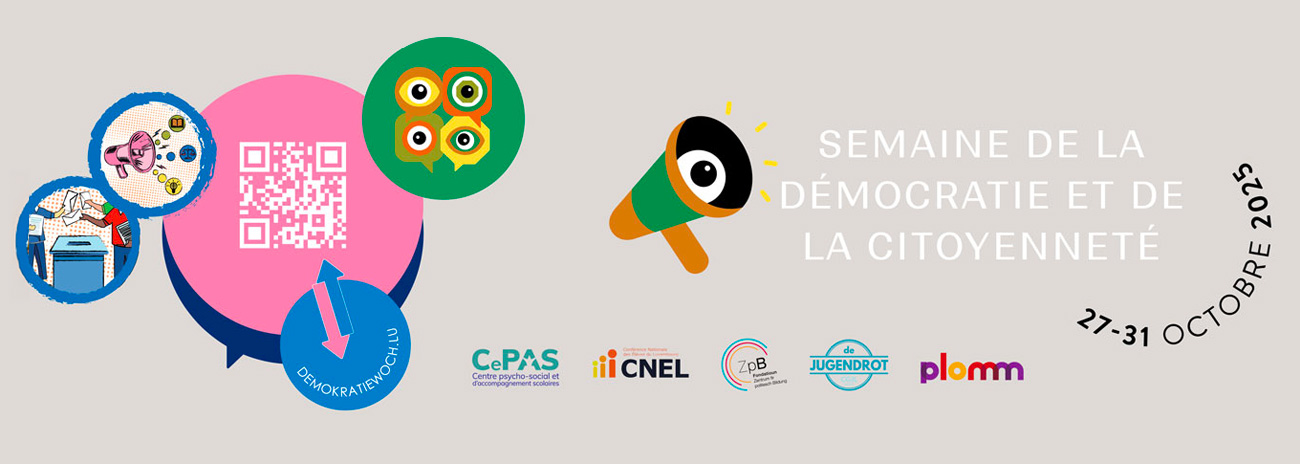
The 2025 edition is the result of a collective and democratic effort between various stakeholders working toward a more participatory and engaged society.
It is implemented by CePAS, the Zentrum fir politesch Bildung (ZpB), the National Student Conference (CNEL), the Jugendrot, the Department for Children’s Rights of the Ministry of Education, Children and Youth, the Agence Qualité , the Direction Générale du Secteur d l’Enfance, the Direction de l’enseignement fondamental, and the KannermuséePLOMM.
Each of these partners actively contributes to the design, coordination and implementation of the activities of the Week.
Service des droits de l’enfant – Department for Children’s Rights
The Ministry of Education, Children and Youth coordinates Democracy Week through its Department for Children’s Rights, the General Directorate for Childhood, the General Directorate for Primary Education and CePAS.
The Department for Children’s Rights ensures the implementation of the United Nations Convention on the Rights of the Child across the various ministries, institutions and organisations responsible for this mission.
It also takes part in inter-ministerial consultations and in the work of international bodies, which monitor the conventions ratified by Luxembourg on children’s rights, and promotes the exchange of good practices that may be adapted at national level.
In partnership with private organisations, the Department develops guides and reference documents, as well as awareness-raising actions and campaigns.
Its work is based on the four fundamental principles of the Convention on the Rights of the Child:
- non-discrimination
- the best interests of the child
- the right to survival and development
- the right to participation
Direction Générale du Secteur d l’Enfance (General Directorate for the Childhood Sector) – DGE
The General Directorate for the Childhood Sector (DGE) is responsible for issuing the authorisations required to operate in the non-formal education sector and contributes to the funding of education and care structures. The DGE manages their administrative follow-up and provides guidance on administrative and procedural matters. It is also responsible for monitoring and managing funding, notably through the chèque-service accueil scheme, as well as overseeing the financial supervision of so-called “contracted” structures.
To ensure consistent quality across the sector, the DGE defines and oversees the implementation of quality standards, both structural and pedagogical, as set out in legislation and in the National Reference Framework for Non-Formal Education for Children and Young People. These standards guarantee compliance with the fundamental principles of non-formal education, such as children’s rights, inclusion, participation and multilingualism.
The service ensures compliance with legal standards through regular inspections and handles complaints and claims related to the functioning of the structures.
In order to respond to societal developments, its mission is to create a legal and financial framework that supports the development of a diverse, accessible and equitable educational offer that promotes children’s well-being and social inclusion. Policy development and strategic guidance are carried out in close consultation with representatives of the non-formal education sector.
The role of the DGE also includes promoting non-formal education and helping to raise awareness of the educational mission of non-formal education structures.
Agence pour le développement de la qualité dans les secteurs de l’Enfance et de la Jeunesse (Agence Qualité)
The Agency for Quality Development in the Childhood and Youth Sectors (hereafter referred to as the Agence Qualité) offers a structured, innovative and collaborative approach to sustainably strengthening quality in the childhood, youth, and child and family support sectors.
The Agence Qualité operates through three complementary pillars:
Support for structures
Its quality advisors support structures in their quality processes through personalised guidance, without any supervisory or control mandate.
Professional development
It coordinates a programme of continuing training and coaching, designed and delivered by specialised organisations, aligned with professional realities and field needs.
Educational innovation
Through its LumiQ space, the Agence Qualité supports co-creation, experimentation and the development of innovative projects emerging from the field, in collaboration with stakeholders across the relevant sectors.
Through these actions, the Agence Qualité supports the further development of practices and the professionalisation of the sector, fostering sustainable and shared transformation.
Learn morePsycho-Social and School Support Centre (CePAS)
CePAS is committed to promoting the well-being and personal development of young people at school, supporting them on personal, relational and academic levels. Their mission is carried out in collaboration with members of the school community, including young people, parents, teachers, and educational and psycho-social staff.
Its overall mission is to promote well-being, mental health, non-formal education and youth participation within the school environment.
Please find below the documents related to the 2025 Democracy Week by CePAS:
Agenda – Democracy Week 2025 (PDF)
Call for Participation – Democracy Debate 2025 (PDF)
Guidelines – Democracy Week 2025 (PDF)
Practical Guide – Democracy Week 2025 (PDF)
Democracy Week – CePAS – Luxembourg
Learn moreZentrum fir politesch Bildung
The Zentrum fir politesch Bildung (ZpB) is an independent foundation whose mission is to promote citizenship by fostering a better understanding of democracy and current societal issues. It places a particular emphasis on the engagement of children and young people, while addressing the population as a whole.
Under the motto “Demokratie léieren a liewen” (learning and experiencing democracy), the ZpB supports children, young people and adults in discovering political mechanisms, democratic processes and core principles. It strives to make these concepts concrete and accessible, thereby helping to strengthen democratic culture in schools, extracurricular settings and society at large.
The ZpB promotes active citizenship education and supports the development of a vibrant and participatory democracy. Once again this year, it is organising — in collaboration with the Ministry of Education, Children and Youth — the conference “Meng Stëmm, Mäin Impakt – Kanner schwätze mat!”, which will take place on 28 October 2025.
On their website (www.zpb.lu), you will find educational materials to consult and download, adapted to the various target audiences of Democracy Week, as well as full details of the educational events available in our Agenda.
Learn moreConférence Nationale des Élèves (CNEL)
The Conférence Nationale des Élèves (CNEL) is an independent platform representing students at national level. It brings together elected representatives from all secondary schools in the country, ensuring that students’ voices are heard nationwide.
The CNEL enables young people to express their views on topics related to their school life and future, whilst also serving in an advisory role to the Ministry of Education. Its members debate, formulate concrete proposals and issue official opinions on a wide range of subjects, such as school curricula or any other matter affecting young people.
Learn moreJugendrot
Founded in the early 1960s under the name Conférence Générale de la Jeunesse Luxembourgeoise (CGJL asbl), Jugendrot is the umbrella organisation that brings together youth organisations across the Grand Duchy of Luxembourg.
Its members come from a wide range of backgrounds: political and trade union youth movements, scout & guide organisations, socio-cultural and socio-educational groups, as well as leisure organisations. With a diverse network of 35 member organisations, Jugendrot / CGJL amplifies the voice of young people at both the national and international levels.
Its activities include:
- training programmes
- support services for the Youth Parliament and the National Student Conference (CNEL)
- the organisation of the Rallye Citoyen and the Youth Convention
- information and awareness-raising campaigns
- round tables and conferences on democratic processes and active citizenship
Kannermusée PLOMM
Since 2023, the PLOMM Children’s Museum has been one of Luxembourg’s resource centres for non-formal education. With a strong focus on children’s participation, it aims to offer pedagogical support to educational staff while developing and promoting non-formal educational methods.
Through art and culture, PLOMM actively lives and promotes children’s participation. By offering artistic and cultural experiences, children aged 0 to 12 are encouraged to exchange ideas, develop their creativity and strengthen their critical thinking skills. The permanent exhibition “The Story Tree”, together with temporary exhibitions supported by age-appropriate mediation, allows children to immerse themselves in different worlds. Through workshops and participatory projects, they are invited to express their ideas, becoming researchers and artists in their own right.
With the aim of listening to and valuing children’s voices, the PLOMM Children’s Museum is committed to encouraging dialogue and promoting democratic values, while supporting inquiry-based approaches, self-expression and artistic creation. Recognised as responsible citizens of today and tomorrow, children can develop their potential while enjoying the learning process.
Learn more