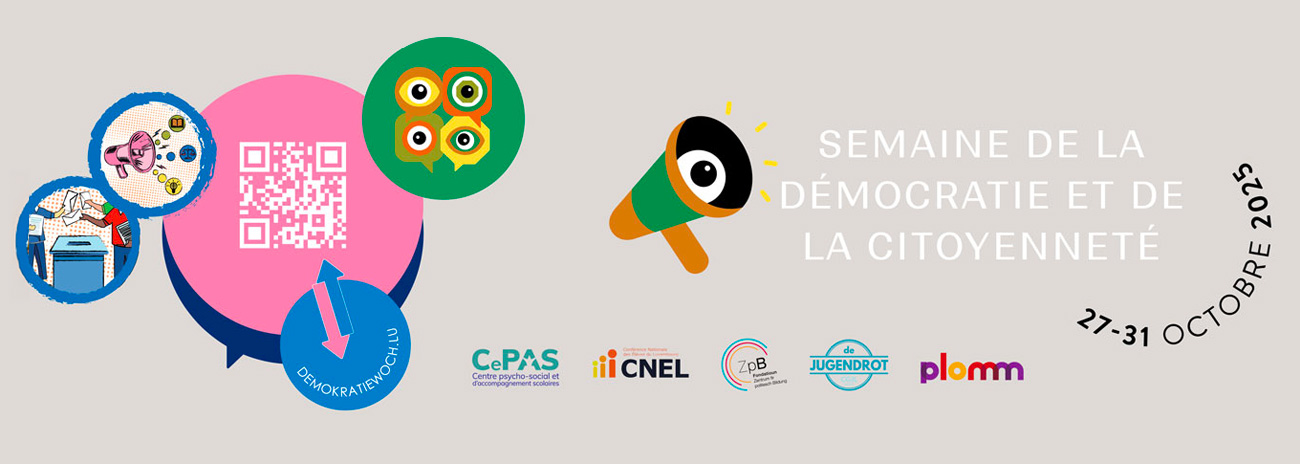
27–31 October 2025
Democracy is experienced every day, and it begins at a very young age.
copyright CePAS
Democracy is never guaranteed; it is built day by day through everyone’s participation. This is the spirit behind our Democracy Week — a week dedicated to the active participation of children and young people, both in formal and non-formal education settings.
This week aims to raise awareness about the importance of democracy. It offers primary schools, secondary schools, and non-formal education services the opportunity to set up flexibly learning situations that allow children to experience democratic processes in a safe environment, to explore civic engagement and to reflect together on current issues.
It also helps highlight democratic values and encourages active citizenship. Speaking up, debating, collaborating, getting involved in community life, learning with peers and adults — all of these are opportunities to bring democracy to life.
Do you have questions about Democracy Week?
Check out our FAQ below!
It is a national week dedicated to the participation of children and young people. Its goal is to strengthen their role in democratic life, both at school and within childcare and educational structures.
Students are encouraged to debate, express themselves, propose ideas and carry out concrete actions — individually or in groups — with the support of adults.
Democracy Week was created in 2021 on the initiative of CePAS, the Zentrum fir politesch Bildung, the Jugendrot, and the National Student Conference (CNEL).
Its aim was to provide a national framework to encourage young people’s participation at school and in society.
Since then, it has expanded to include primary education and non-formal education structures (such as day-care centres, youth homes, mini-crèches, etc.).
For more information, visit the About Us page.
The aim is to promote active citizenship by acknowledging children and young people as experts in their daily experience of educational policies.
During the week, children and young people can:
- be informed and heard fairly
- be consulted on topics that directly concern them
- bring students’ voices and proposals to decision-makers
- receive feedback on their proposals and initiatives
- organise peer-to-peer learning activities
- showcase their engagement through projects that contribute to a more democratic school
- encourage intergenerational exchanges and co-create projects that respond to their concerns
Consult the guidelines on the Resources page to learn more.
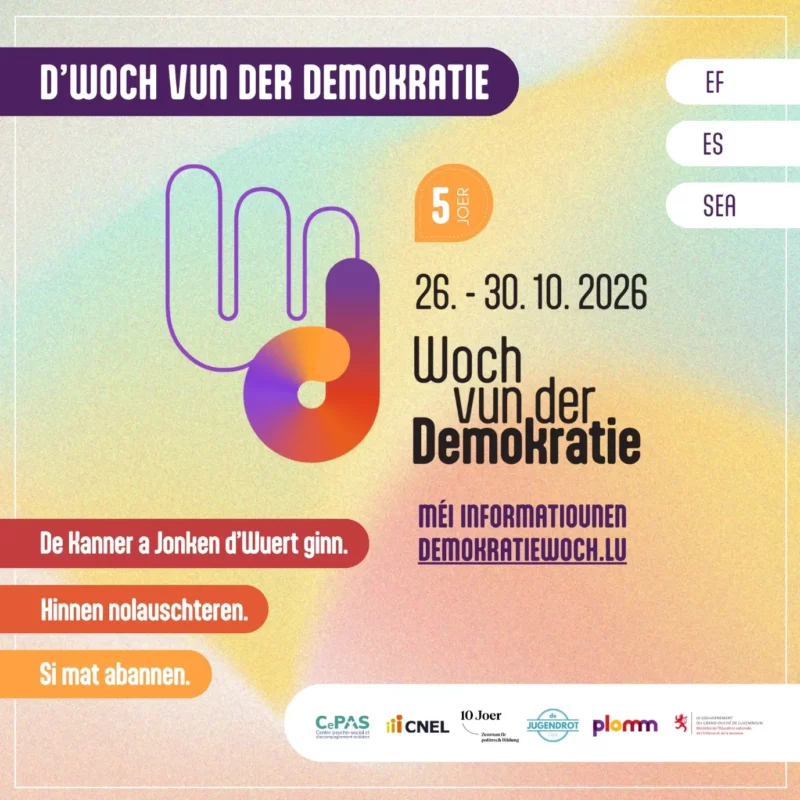
Each year, the Week takes place during the week preceding the autumn half-term school holidays.
In 2025, it will take place from 27 to 31 October.
The Week provides a space to:
- present and highlight existing projects
- launch new creative initiatives
- strengthen democratic processes within schools
Its success depends on the engagement of everyone taking part in an activity during the Week. It therefore relies on the participation of primary schools, secondary schools, and childcare and education structures.
Discover the activities currently underway on the Agenda page.
A wide variety of formats can be used, suitable for all ages:
- In the classroom: talking circles or structured dialogue spaces, discussions about rights or school rules, class councils (Klassenrot), surveys, student newspapers…
- Within the school: debates, exhibitions, competitions, creative workshops, participatory games, consultations, voting…
- Spaces for free expression: open forums, opinion walls, “democracy trees”, suggestion boxes…
- External partnerships: visits to local municipalities, meetings with elected representatives or local associations…
- Reflection time: evaluation, planning perspectives, long-term commitment.
Because democracy is not only experienced by voting once every five years. It is learned, practiced, and lived every day — especially in the way we interact, make decisions, respect others and manage disagreements.
All children and young people, from primary education and secondary school, can participate. Activities can also be organised in non-formal education settings (day-care centres, after-school facilities, mini-crèches, etc.).
There is no mandatory theme, but some years, we may propose guiding themes (such as freedom of expression, children’s rights or social justice). Projects can follow these themes or be adapted to the specific needs of each participating structure.
Visit our Resources page: you will find an idea box filled with activity suggestions suitable for all ages and various contexts.
Some are ready-to-use and easy to implement, whilst others can be adapted to your needs. They were created in collaboration with various partners so that everyone can take part — even those without much time or resources to design everything from scratch.
Let yourself be inspired, adapt and get started!
Not at all. Democracy Week is above all a catalyst: it provides visibility and momentum, but the goal is to encourage a lasting dynamic throughout the year.
Projects may begin beforehand, continue afterwards or be part of ongoing commitments to the topic. What matters is promoting regular and structured participation by children and young people — at school and in other places where they live and learn.
Visit the Your Actions page to find out how to propose an activity for children and young people related to democracy, citizenship, children’s rights or participation.
A broad partnership coordinates the Week, including:
- CePAS
- Zentrum fir politesch Bildung (ZpB)
- Jugendrot
- CNEL
- The Department for Children’s Rights of the MENEJ
- The General Directorate for Primary Education
- The Agency for Quality Development in the Childhood and Youth Sectors (ADEQSEJ)
- The General Directorate for the Childhood Sector
- The Kannermusée Plomm
And above all: schools, secondary schools, day-care centres, youth homes, and youth structures across the country.
More information about the partners is available on the About Us page.
